|
Советская элегия (1989)
Character: Self
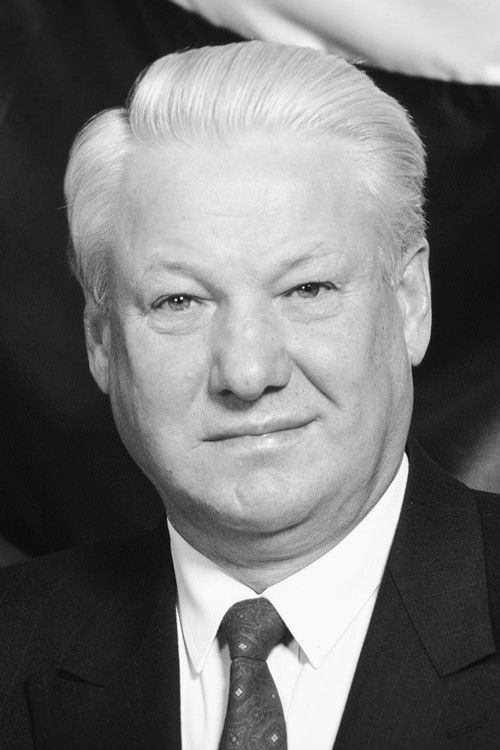
In "The Soviet Elegy" the long train of photos of the Soviet leaders, dead or alive, stops at the portrait of Yeltsin. At the time of shooting Yeltsin had fallen down from the assembly of the Communist Party deities, and participated in the earthly life through connections of different kinds.
|
|

|
Пример интонации (1991)
Character: Self
The second film by Sokurov featuring Boris Yeltsin as the principal character. Now he is the President of Russia, invested with power, bearing the full responsibility for the destinies of his distant compatriots as well as his closest kin and friends.
|
|
|
|
Точка РФ (2018)
Character: Self (archive footage)
Documentary montage film by Alexander Vartanov, a subjective look at the beginning of the 21st century in Russia
|
|

|
День откровения (1989)
Character: N/A
About the leaders and the nature of the activities of informal groups in Moscow: “Democratic Union” and “People’s Front”.
|
|

|
Biography: Boris Yeltsin (2000)
Character: Self
He has been called both a democrat and a drunk, a dictator and a czar. For most of a decade, he undertook the seemingly impossible task of dragging his giant nation to the center of global politics and economics. Boris Yeltsin's political career is similar to that of President Lincoln, who was born in a log cabin and rose to the White House. A former construction foreman, Yeltsin survived numerous crises to remain in control of Russia since the collapse of communism. Despite rumors of illness, strong opposition, and questionable decisions, he never lost an election. Travel with us to Russia to see an intimate portrait of one of the world's most contradictory leaders.
|
|

|
Немцов (2016)
Character: Self (archive footage)
A story told by those who knew Boris Nemtsov at different times: when he was a young scientist and took his first steps in politics; when he held high government offices and was considered Boris Yeltsin's heir apparent; when he led Russia's democratic opposition to Vladimir Putin.
|
|
|
|

|
Russie, Chine, Iran : La revanche des empires (2024)
Character: Self (archive footage)
Russia, China and Iran: three former empires are determined to take their revenge and reassert their power after centuries of humiliation. Since the start of the war in Ukraine, they have never been so aligned on the international stage. Their common goal: to put an end to Western hegemony, restore their zone of influence and propose a new model of society. To achieve this, they are waging a hybrid war against the democracies: military, technological, economic, informational and ideological. Are they on the verge of joining forces to create a new world order?
|
|
|
|

|
Khodorkovsky (2011)
Character: Self (archive footage) (uncredited)
Khodorkovsky, the richest Russian, challenges President Putin. A fight of the titans begins. Putin warns him. But Khodorkovsky comes back to Russia knowing that he will be imprisoned, once he returns. When I heard about it, I asked myself: why didn't he stay in exile with a couple of billions? Why did he do that? A personal journey to Khodorkovsky.
|
|

|
Dokument inifrån: Vad hände med försvaret? (2015)
Character: Self - F.d. Rysslands president (Archive footage)
15 years ago, the Swedish defense took time out to become more modern and sharper. Today, the outside world and politicians are amazed at how little was left. What actually happened?
|
|

|
Слишком свободный человек (2017)
Character: Self (archive footage)
A documentary about Boris Nemtsov, a prominent figure of Russian political opposition and an outspoken critic of Vladimir Putin. Nemtsov was murdered in Moscow in February of 2015.
|
|

|
Baltic Storm (2003)
Character: Self (archive footage) (uncredited)
A journalist from Berlin, Germany, and a Swedish lawyer discover the truth behind the sinking of the "MS Estonia" in 1994, where more than 850 people drowned.
|
|

|
The Shock Doctrine (2009)
Character: Self (archive footage)
An investigation of "disaster capitalism", based on Naomi Klein's proposition that neo-liberal capitalism feeds on natural disasters, war and terror to establish its dominance.
|
|

|
1996, hold-up à Moscou (2021)
Character: Self (archive footage)
Moscow, January 1996. Boris Yeltsin gets ready to run for a second mandate of the presidency of the young Russian Federation. Polls are in the single digits. A painful economic transition, war in Chechnya, and the rise of criminal groups have left the majority of Russians dissatisfied with Yeltsin… and willing to vote for the communist leader Gennady Zyuganov. Yet six months later, Yeltsin won the election with nearly 54% of the vote. How did that happen?
|
|
|
|

|
Свидетели Путина (2018)
Character: Self - Politician (archive footage)
Russian Federation, December 31, 1999. After President Boris Yeltsin's unexpected resignation, Prime Minister Vladimir Putin becomes acting president of the country. From that day and for a year, Vitaly Mansky's camera documented Putin's rise to power. The story of a privileged witness. The harsh explanation of the reason why politics is the art of possibility of achieving the best with the support of many, but also of giving the worst in return.
|
|

|
Близкие (2025)
Character: self (archive)
The film chronicles the final journey of 88-year-old Russian former top-secret scientist and philanthropist Dmitriy Zimin, alongside his longtime American friend Augie Fabela, acting US police officer, before Zimin’s scheduled euthanasia. Against the backdrop of geopolitical tensions between Putin’s Russia and the USA and the outbreak of war in Ukraine, the film captures the closing scenes of a life and a time of peace. Zimin’s story is an embodiment of the harsh historical cycles that have defined Russia over the past century.
|
|

|
Гражданин Х (2019)
Character: Self (archive footage)
The strange case of Mikhail Khodorkovsky — once believed to be the wealthiest man in Russia — who rocketed to prosperity and prominence in the 1990s, served a decade in prison, and became an unlikely martyr for the anti-Putin movement.
|
|

|
Biélorussie, une dictature ordinaire (2018)
Character: Self (archive footage)
It’s the last dictatorship of Europe, caught in a Soviet time-warp, where the secret police is still called the KGB and the president rules by fear. Disappearances, political assassinations, waves of repression and mass arrests are all regular occurances. But while half of Belarus moves closer to Russia, the other half is trying to resist…
|
|

|
Новые сведения о конце света (1991)
Character: Self
A crazy documentary about the dawn of occult movements related to the expectation of the end of the world, after the collapse of the USSR!
|
|

|
Soviet Union: The Rise and Fall - Part 2 (1996)
Character: Self (archive footage)
Historic Russian battles to repel invaders serve as prelude to the story of events that redrew the map of Eastern Europe and parts of Asia in the 20th century. Following the turmoil of the Bolshevik Revolution, Communist Russia faces the venom of Nazi aggression. 1940's film footage reveals the harsh reality of total war, as the Red Army and Soviet civilians alike confront a brutal and tenacious enemy. The following decades are darkened by tensions between the USSR and foreign powers, and violent measures taken to silence voices of dissent. Finally, the Soviet people's yearning for a freer society leads to accelerating reforms and the ultimate dissolution of the USSR.
|
|

|
Gazprom - Die perfekte Waffe (2023)
Character: Self (archive footage) (uncredited)
The war in the Ukraine has changed the way many European countries view Russian politics. Suddenly it became clear how dependent countries had become on Russian gas imports for decades and what Vladimir Putin was up to. However, no country needs more gas than Germany. It was only after Russia's invasion of the Ukraine that the German government realized that Russia had long used gas as a weapon to impose its will on states. The instrument created for this purpose is the natural gas production company GAZPROM. So how did Germany become so dependent on Russian gas? The documentary shows how, over several decades and several changes of government, a broad alliance of politicians and business representatives did everything possible to secure Germany's energy supply with cheap Russian gas, while the Kremlin's foreign policy became increasingly aggressive and the warnings of experts went unheeded.
|
|