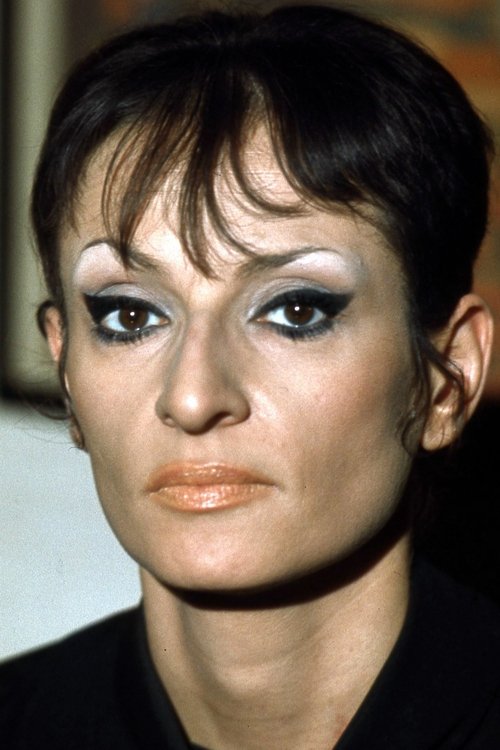
Biography
Monique Andrée Serf (9 June 1930 – 24 November 1997), known as Barbara, was a French singer. She took her stage name from her grandmother, Varvara Brodsky, a native of Odesa, Ukraine. Barbara became a famous cabaretière in the late 1950s in Paris, known as La Chanteuse de minuit ('the midnight singer'), before she started composing her own tracks, which brought her to fame. Her most famous songs include "Dis, quand reviendras-tu ?" (1962), "Ma plus belle histoire d'amour" (1966) and "L'Aigle noir" (1970), the latter of which is said to have sold over 1 million copies in just twelve hours.
Born on Rue Brochant in Paris to a Jewish family. Her father, Jacques Serf (1904-1959), was a leather salesmen of Alsatian origin and her mother, Ester Brodsky (1905-1967), was a civil servant from Tiraspol. She was the second of four children: Jean (born 1928), Régine (born 1938), and Claude (born 1943). Barbara lived in northwestern Paris as a child. She then lived in Roanne starting in 1938, and in Tarbes starting in 1941. Barbara was 13 years old when she went into hiding during the German occupation of France during World War II. Her family was hidden by the family of conductor Jean-Paul Penin from 1943 to 1945, first in Préaux and then in Saint-Marcellin.
After the war ended, Barbara's family came back to Paris in 1946, and settled on Rue Vitruve in the 20th arrondissement. Her childhood dream was to become a pianist, but a problem with her hand made such a career impossible. To console her, her parents agreed to pay for singing lessons. A neighbourhood music professor, who heard her sing, took an interest in helping her develop her talents. She was given vocal lessons and taught to minimally play the piano; eventually she enrolled at the École Supérieure de Musique in 1947. Money was a problem and she gave up her musical studies in 1948. She was first recruited at the Théâtre Mogador, before a stint in Belgium, where she performed under the stage name Barbara Brodi. Late 1951, she returned to Paris to audition at La Fontaine des Quatre Saisons, a popular cabaret in the 7th arrondissement. However, as she failed to become a permanent cast member, she returned to Brussels. In 1955, she returned to Paris; with more luck, she began to sing at various cabarets throughout the capital, with a growing audience.
She was deeply scarred by the war and her family's plight. The feelings of emptiness experienced during childhood showed in her songs, particularly "Mon Enfance". She said in her uncompleted autobiography, Il était un piano noir (assembled from notes found after her death), that her father sexually abused her when she was 10 and she hated him for that. He later abandoned the family.
A tall person, Barbara dressed in black as she sang melancholy songs of lost love. From 1950 to 1951, after her father's desertion of her family, she lived in Brussels, where she became part of an active artistic community, before visiting Charleroi, where she befriended many artists. Her painter and writer friends took over an old house, converting it into workshops and a concert hall with a piano where she performed the songs of Édith Piaf, Juliette Gréco and Germaine Montero. However, her career evolved slowly and she struggled constantly to eke out a living. ...
Source: Article "Barbara (singer)" from Wikipedia in English, licensed under CC-BY-SA.