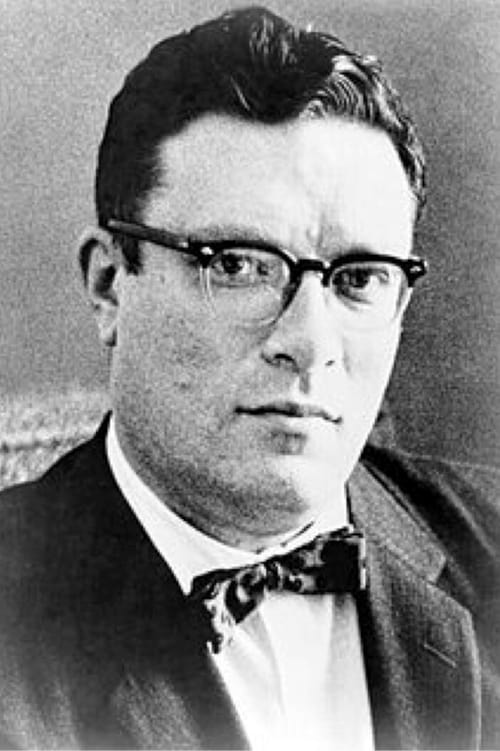
Isaac Asimov

Personal Info

Known For

Writing

Known Credits

1.5729

Gender

Male

Birthday

02-Jan-1920

Age

(106 years old)

Place of Birth

Petrovichi, Russia

Also Known As
  • Isaak Yudovich Ozimov

Isaac Asimov

Biography

Isaac Asimov (born Isaak Yudovich Ozimov, January 2, 1920 – April 6, 1992) was an American author and professor of biochemistry at Boston University, best known for his works of science fiction and for his popular science books. Asimov was one of the most prolific writers of all time, having written or edited more than 500 books and an estimated 9,000 letters and postcards. His works have been published in nine of the ten major categories of the Dewey Decimal System (The sole exception being the 100s: philosophy and psychology, although he did write a foreword for The Humanist Way, which is published in the 100s). Isaac Asimov is widely considered a master of hard science fiction and, along with Robert A. Heinlein and Arthur C. Clarke, he was considered one of the "Big Three" science fiction writers during his lifetime. Asimov's most famous work is the Foundation Series; his other major series are the Galactic Empire series and the Robot series, both of which he later tied into the same fictional universe as the Foundation Series to create a unified "future history" for his stories much like those pioneered by Robert A. Heinlein and previously produced by Cordwainer Smith and Poul Anderson. He wrote many short stories, among them "Nightfall", which in 1964 was voted by the Science Fiction Writers of America the best short science fiction story of all time. Asimov wrote the Lucky Starr series of juvenile science-fiction novels using the pen name Paul French. The prolific Asimov also wrote mysteries and fantasy, as well as much non-fiction. Most of his popular science books explain scientific concepts in a historical way, going as far back as possible to a time when the science in question was at its simplest stage. He often provides nationalities, birth dates, and death dates for the scientists he mentions, as well as etymologies and pronunciation guides for technical terms. Examples include his Guide to Science, the three volume set Understanding Physics, Asimov's Chronology of Science and Discovery, as well as numerous works on astronomy, mathematics, the Bible, William Shakespeare's works and, of course, chemistry subjects. Asimov was a long-time member and Vice President of Mensa International, albeit reluctantly; he described some members of that organization as "brain-proud and aggressive about their IQs." He took more joy in being president of the American Humanist Association. The asteroid 5020 Asimov, a crater on the planet Mars, the magazine Asimov's Science Fiction, a Brooklyn, New York elementary school, and one Isaac Asimov literary award are named in his honor. Description above from the Wikipedia article Isaac Asimov, licensed under CC-BY-SA, full list of contributors on Wikipedia.​


Credits

Isaac Asimov: Voyage to the Outer Planets & Beyond Isaac Asimov: Voyage to the Outer Planets & Beyond (1986) Character: Self - Host
Travel to the edges of our solar system with this unique blend of photographic images, video and computer animation. Hosted by renowned scientist and author Isaac Asimov, the program is set to Gustav Holst's moving 1917 musical suite "The Planets." The infrequently seen footage from NASA includes images of planets and other impressive galactic bodies, including Jupiter, Saturn's rings, Pluto and much more.
Towards Tomorrow: Robot Towards Tomorrow: Robot (1967) Character: Self - Presenter
Documentary from 1967 on how robotics could shape human society. Your future is being created now - for better or for worse? How close are we to constructing the robot of the future? Will there be one in every house? How human will It look? These are some of the questions this programme tries to answer. Isaac Asimov, science fiction writer and prophet of the robot age, introduces the programme and predicts a future in which man and robots form a combined culture. A culture in which, to use his own words, 'mankind may want robots not only as helpers and servants but also as friends, as something with which they can identify'. Towards Tomorrow explores laboratories in England and America to discover how near scientists and engineers are to turning Asimov's science fiction into science fact.
Since '45 Since '45 (1979) Character: Self
Produced in 1979, this classic short documentary explores the mass media and its impact upon society, uncovering shocking details showing how in many cases it is the media itself that drives the news cycle.
Этот фантастический мир. Фильм 12 Этот фантастический мир. Фильм 12 (1987) Character: (archive)
Based on science fiction stories about the relationship between man and robot: A. Belyaev’s “Open Sesame” about how a robot servant robbed two old men; A. Azimova's "Liar" about a robot who can read minds and turns out to be the most humane among people; F. Chilander's "Court" about how robots tried the last person living in the city.
Who's Who Who's Who (1986) Character: N/A
Produced for American Public Television, this documentary on the long-running Doctor Who television series features interviews with actors and actresses who played the traveling companions of the Time Lord hero and with three actors, Jon Pertwee, Peter Davison, and Colin Baker, who portrayed the title character, as well as footage of a U.S. fan convention where Tom Baker, appeared and answered questions. The fan backlash against the 1985-6 hiatus for the series and the finding of some previously lost Jon Pertwee era episodes are addressed, and this documentary closes with some on-the-street interviews with British viewers, who tell who their favorite Doctor is.
Target... Earth? Target... Earth? (1980) Character: Self
Really strange documentary of Wheeler Dixon production quality on the Tunguska Event and the possibility of it happening again causing an apocalypse (basically a meteor scare film) sprinkled with UFO conspiracy kooks, and other 'professionals', riddled with stock footage of all kinds, freaky moog music and sound fx, a Dr. Who rip-off end theme, Victor Buono as Homer the Archivist, a philosophical history recorder in a space ship with a HAL 9000 type talking computer named Ino, there's also another space ship with Egyptian looking aliens girls with pasties and see-thru blouses.
The Magnificent Major The Magnificent Major (1977) Character: Self - Guest Host
A young girl learns the importance of reading, when she ends up in a dystopian future where reading is banned.
Isaac Asimov : L'Étrange Testament du père des robots Isaac Asimov : L'Étrange Testament du père des robots (2022) Character: Self (archive footage)
With over 500 publications to his name, from the 50’s to the 80’s, he had anticipated computers and electronic gadgets invading the household, autonomous vehicles and man’s withdrawal from nature. Science fiction and anticipation stories have never been as popular as today. It inspires literature, drama series, films, even politics and the military. As the world we live in faces an unprecedented technological acceleration, we are more concerned than ever by the issue of our future.


Our Work is

Designed, crafted, and built with ❤️ for fans of all kinds.


Anime | Movie
2024 Animeperson . All Rights Reserved